

Explore Listing
When the 2nd Battalion The Royal Inniskilling Fusiliers returned from Cyprus in February 1956, it was honoured at its Farewell Parade on 16 February, in Whittington Barracks Lichfield, by the presence of The Colonel in Chief, HRH The Duke of Gloucester. Following a period of leave the Battalion reassembled on 30 May at Omagh. The Battalion's Colours were laid up in Enniskillen Cathedral on 13 June and the Battalion was officially disbanded on 1 September 1956 when it was removed from the Army Order of Battle.
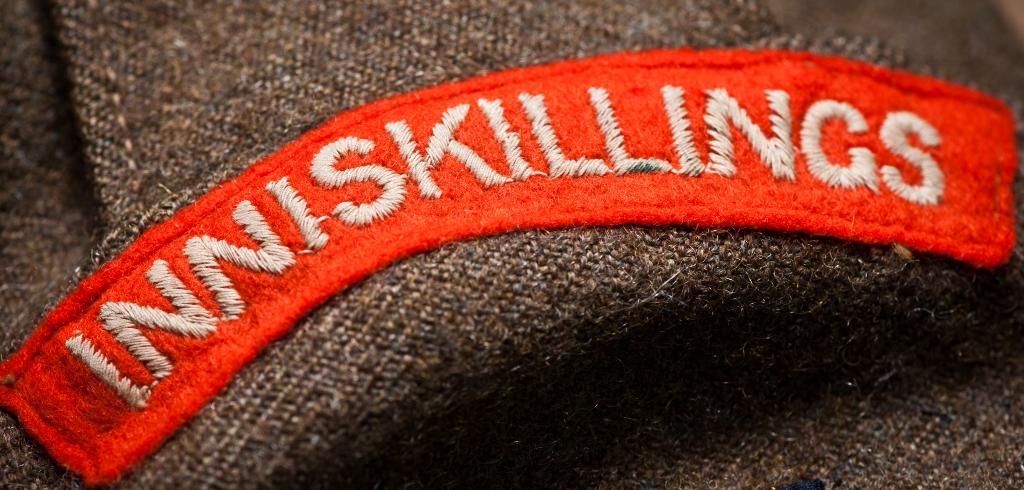 The 2nd Battalion The Royal Inniskilling Fusiliers, having had seven days rest, returned to the battlefront on Monte Damiano on 10 February 1944 and was in trenches on 17 February.
During the great strike on the railways of England in 1911, troops were ordered to districts were there were disturbances. The 2nd Battalion The Royal Inniskilling Fusiliers entrained in Aldershot for London on 17 August for deployment to Darlington, Yorkshire where the Battalion then guarded railway stations and engine works. A detachment sent to Shildon, the cradle of railway engineering, was stoned by rioters, but there were no serious casualties when the strike ended, the Battalion returned to Aldershot on 26 August 1911.
The 3rd Battalion The Ulster Defence Regiment took over responsibility for East and South Down from the Regular Army.
The 3rd Battalion The Ulster Defence Regiment's Newry Company deployed to Narrow Water near Warrenpoint to support the follow-up operation to the aftermath of two explosions, the first had killed sixteen members of the 2nd Battalion The Parachute Regiment, and the second, the Commanding Officer and his radio operator from the 1st Battalion The Queens Own Highlanders. It was the IRA's deadliest attack on the British Army during Operation BANNER, the military operational deployment to Northern Ireland during the 'troubles'.

Great gains were being made all along the Western Front in the first weeks of October 1918. The 36th (Ulster) Division was to advance to the River Lys and drive the enemy out of the industrial area of Lille-Tourcoing-Roubaix. The attack began on 14 October and by 16 October it reached the line of the Lys where the Germans had blown the bridges. Despite D Company of the 9th Battalion The Royal Irish Fusiliers* getting a group across a pontoon bridge, it was cut off when effective German artillery fire damaged the bridge.
Major General Nugent* and his Staff arrived at Boulogne, France at midnight on the 3 October 1915. Between the 5 - 9 October, the 36th (Ulster) Division concentrated in the area round its Headquarters at Flesselles to the north of Amiens.
*
Later to become Major General Sir Oliver Nugent KCB DSO, his home was Farren Conncil, Mount Nugent in County Cavan, Ireland.
Following the successful German attacks on St Quentin on 21-24 March 1918, the British withdrew westwards and the French southwards with the result that a gap appeared in the Allied line on the morning of 26 March.
Following the German's 1918 Spring Offensive, or Kaiserschlacht (Kaiser's Battle), the 36th (Ulster) Division was withdrawn from the front on the 29-30 March 1918 for reorganization. For 107 Brigade, this meant marching to the railhead at Saleux, a journey of over 30 miles.
 By 1500 hours on 14 June, the 6th Battalion The Royal Inniskilling Fusiliers had formed a bridgehead across the River Paglia, a tributary of the Tiber north of Rome. In response to German countermoves, the bridgehead was extended by moving the 2nd Battalion The London Irish Rifles further to the north to occupy the Morrano Ridge dominating Route 71.