

Explore Listing
The Gorget was originally a piece of armour that was designed to protect the throat. From the 18th century the gorget gradually went out of use and was abolished in 1830. The Portavoe Fuziliers were yeomanry raised in the 1790s in response to the threat of invasion by France.
This model of the Bren Light Machine Gun is a Mark 3 from 1947 but had only minor improvements on the .303 inch light machine gun that was used by the British Army since 1937 and particularly throughout the Second World War.
Its versatility, robustness and significant calibre ensured that it was considered to be one of the best light machine guns in the world. It continued in use by the British Army through the Korean War, the Mau Mau Uprising, the Northern Ireland Troubles, the Falklands War and the Gulf War.
To watch a British Pathé period film please click on:
This is a Military General Service medal awarded for service during 1793 to 1814, including the Napoleonic Wars.
The Ulster Division was formed in September 1914 from 'battalions' of the Ulster Volunteer Force (UVF).
The UVF was raised by Sir Edward Carson in 1912 from primarily Protestant supporters of the Union between Great Britain and Ireland. This was a direct challenge to the passing of legislation by the British Government that would give Home Rule to Ireland. This armed and drilled paramilitary force was prepared to oppose, by force of arms, the imposition of Home Rule in the nine counties of Ulster. In response, Irish nationalists raised and armed their own Irish Volunteers.
David Nial Creagh O’Morchoe was born in Dublin on 17 May 1928. Generations of his family had farmed in Wexford until his father and uncles broke with this tradition as a result of ‘The Great War’. His father, Colonel Nial Creagh O’Morchoe, had been commissioned into the 5th Battalion The Leinster Regiment during the First World War before being granted a Regular Commission in the Indian Army in 1917; he later commanded the 4/15 Punjab from 1939-41.
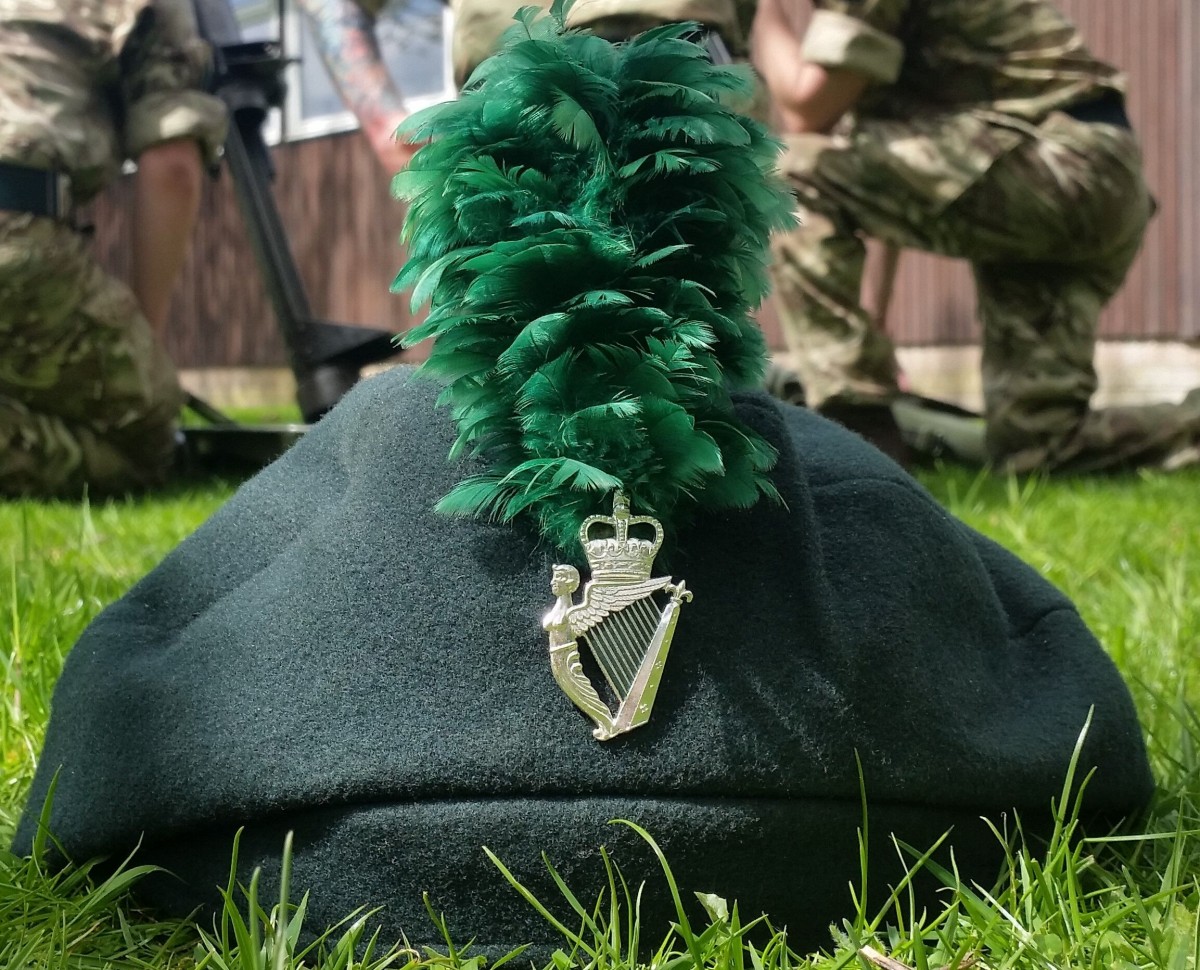 So used are we, in The Royal Irish Regiment, to the sight of the green hackle and to the motto ‘Faugh a Ballagh’ that we often assume that these distinctions have always been with the Regiment and its predecessors. But this is not so, as documents in the National Archives at Kew show.
The whistle was first used by the Light Infantry or Rifles regiments of the British Army from the 19th century. The whistle was used to communicate to soldiers in the noise and heat of battle and there were different whistle calls for different orders in the same way that the infantry used different bugle calls, such as Reveille and Last Post.
The cross belt with whistle attached has been retained as a part of the uniform of today's Royal Irish Regiment, linking the Regiment of today to its antecedent Rifles regiment.
'I have once more to remark upon the devotion to duty, courage, and contempt of danger which has characterized the work of the Chaplains of the Army throughout this campaign.' (Field Marshal Sir John French, after the Battle of Neuve Chapelle, 10-13 March 1915.)
Chaplain to The Forces
Ambassador of Christ you go
Up to the very gates of Hell,
Through fog of powder, storm of shell,
To speak your Master's message: "Lo,
The Prince of Peace is with you still,
His peace be with you, His good-will."
**It is not small, your priesthood's price,
To be a man and yet stand by,
Below is an account of the history of the Irish Great Pipes (píob mhór) and piping in Ireland that appeared in a 1920 print of 'The Pipes of War, a Record of the Achievements of Pipers of Scottish and Overseas Regiments during the War 1914-18'. The term Irish Warpipes, so often used to decribe the píob mhór was in fact an English term.
THEIR HISTORY, DEVELOPMENT, AND DIVERGENCE FROM THE SIMPLE HIGHLAND TYPE
By W. H. Grattan Flood, Mus.D., K.S.G.
The Secretary of State for War, Hugh Childers, restructured the infantry of the British Army in what was known as the Childers reforms of 1881. The 100th (Prince of Wales's Royal Canadian) Regiment of Foot and The 109th Regiment of Foot (Bombay Infantry) were merged, given Irish territorial titles and designated the 1st Battalion and the 2nd Battalion The Prince of Wales's Leinster Regiment (Royal Canadians). Their Home Depot became Crinkill Barracks near Birr, County Offaly. The 3rd, 4th and 5th Battalion were the Militia (Reserve) battalions for the counties of King's, Queen's and Meath.