

The War of The Two Kings
|
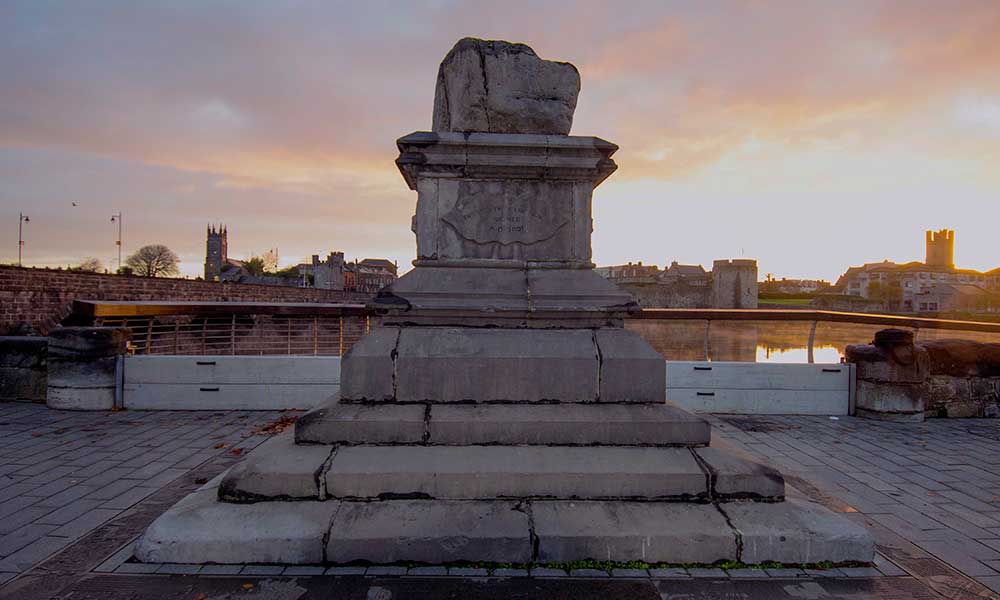
| The Treaty Stone in Limerick, spiritual touchstone of The Wildgeese |
The Williamite War, or The War of The Two Kings (Cogadh an Dá Rí), was the conflict waged in Ireland in the late 17th Century between the Jacobite supporters of King James II and those who supported the claim of William, Prince of Orange (James's nephew and son-in-law through marriage to James's daughter, Mary) to the thrones of England, Scotland and Ireland.
It was a peripheral component of the European great power conflict know as the Nine Years War in which a Grand Alliance, led by William, sought to contain an expansionist France under Louis XIV.
Following William's largely unopposed invasion of England in November 1688, and the rapid collapse of support for the King, James fled to France and placed himself under the protection and sponsorship of Louis XIV. William and his wife, James's daughter Mary, were granted the crowns of England and Scotland jointly by a convention of the English parliament on 13 February 1689 and four weeks later, on 12 March 1689 James landed at Kinsale at the head of 1200 French troops.
He quickly gathered a Jacobite Irish army about him and moved north, intent on securing Ireland as a springboard from which to take back the thrones of England and Scotland. These ambitions were frustrated by the Protestant garrisons of Londonderry and Enniskillen. The Jacobite campaign to encircle and lay siege to Enniskillen was thwarted at The Battle of Newtownbutler on 31 July 1689. This was the first major engagement in which Tiffin's Regiment, later the 27th (Inniskilling), was engaged. Unable to secure Ulster, James's Army withdrew over the Winter and Spring of 1689-90 to the line of the River Boyne beside Drougheda. On 14 June 1690 William landed at Carrickfergus with an army of Dutch, Danish, German and English troops and marched south to meet James in battle.
The Battle of The Boyne took place on 1 July 1690 and saw William's Protestant coalition of some 36,000 attacking James's mostly Irish army of 23,000. It was not a major battle by way of intensity; fewer than 2000 died and Tiffin's Inniskilliners mustered more men after the battle than they had the day before. However, in terms of lasting and symbolic implications, The Battle of the Boyne was huge. It was a clear tactical victory for William, but the Jacobite army was able to retire in moderately good order. The same could not be said of James who bolted for Dublin, Duncannon and thence back to France. His skedaddle earned for him the epithet Séamus an Chaca from his own soldiers.
With James gone, William was able to leave Ireland too, albeit bearing the laurels of victory. The war would grind on for another 16 months with far bloodier engagements following at Athlone, Aughrim and Limerick. The Treaty of Limerick, signed on 3 October 1691, provided for both civil and military settlements. The latter was held to by both parties and allowed some 14,000 Irish Jacobites to sail for France under whose banners they would continue to pursue the Stuart cause for more than half a century. This, The Flight of The Wild Geese established the centuries old and continuing tradition of Irish service in foreign armies.
Sadly for the majority Catholic and Dissenter population of Ireland, the civil articles of the Treaty of Limerick were never honoured and defeat in The War of The Two Kings heralded centuries of oppression and neglect under an Anglican plantation ascendancy.
While the war and its lingering impacts are a matter of historical record, even the titles used to name it remain contentious and subject to cultural perspectives. Whether it is _ An Cogadh an Dá Rí_ - the War of the Two Kings, The Williamite War or The Jacobite War its impacts and cultural symbolism endure.