

The Irish Brigade in the Service of France
|
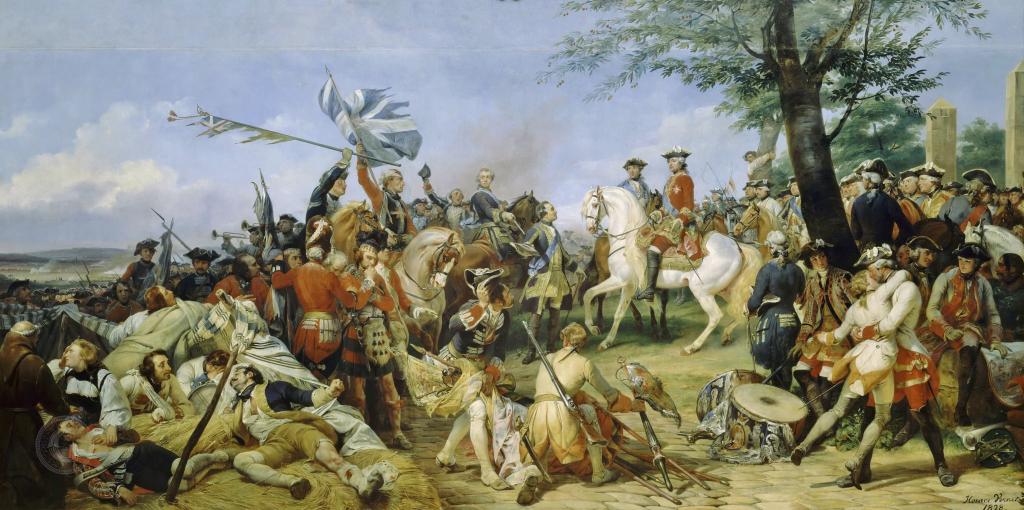
| The Irish Brigade presenting captured British Colours to Louis XV at Fontenoy |
Following the Jacobite failures to capture Londonderry and Enniskillen in 1689, King James II looked to his sponsor, Louis XIV of France, to provide military support for his campaign in Ireland. Louis agreed but insisted on an exchange of troops. In early May 1690 5000 veteran French cavalry and infantry landed in Ireland under General Lauzun to bolster James's army and five regiments of Jacobite Irish were dispatched to France under the command of Justin McCarthy (Lord Mountcashel). These regiments became France's famed "Brigade irlandaise" or The Irish Brigade.
Following The Nine Years War, the remnants of Patrick Sarsfield's Wild Geese were incorporated into the Brigade, fighting with distinction on some of Europe's bloodiest battlefields including Steenkerque (3 August 1692) and Malplaquet (11 September 1709). Louis XIV is said to have complained to Mountcashel that his men were the most boisterous and ungovernable of any in the French service. The Colonel replied:
"The truth of Your Majesty's observation is very clear and very generally acknowledged, for all your enemies say the same".
The Irish Brigade would cement its place in history at the Battle of Fontenoy on 11 May 1745. Placed on the left of the French line, the Brigade charged and crushed the British right at the moment of crisis in the battle, its charge heralded by cries of "Cuimhnígí ar Luimneach agus ar fheall na Sasanach!" (Remember Limerick and Saxon perfidy!). The Brigade captured a number of Colours, including those of the 2nd or Coldstream Guards and the 25th of Foot (Later the 1st Battalion The Royal Regiment of Scotland). The battle was a bloody defeat for the British and, after hearing of the ferocity of The Irish Brigade's attack, King George II is reported to have commented:
"Cursed be the laws that deprive me of such subjects."
Within a year an Irish Brigade piquet of some 650 men would meet another British army, as at Fontenoy, commanded by The Duke of Cumberland. This time they met upon the heathland moor of Culloden on 16 April 1746, where, within the British ranks, were 300 men of the 27th (Blakeney's) Regiment, later The Royal Inniskilling Fusiliers. This time the tide of battle flowed the way of the British. The crushing defeat of the Jacobite Army at Culloden marked the end of the Stuart fight for the thrones of England, Scotland and Ireland.
King George II's lament that the British Army was deprived of Irish soldiers would be addressed by the repeal of the Penal Laws and the subsequent floods of Irish recruits into every regiment of the British Army. This tradition, inheritors of the The Wild Geese, endured beyond Ireland's independence. On 9 October 1941 Churchill wrote to the Chief of The Imperial General Staff, "Pray let me have your views, and if possible your plans, for the forming of an Irish Brigade", a request that led to the formation of 38th (Irish) Brigade in which Irish men from north and south - and from the diaspora - served with distinction in the ranks of the British Army.
It is a tradition that endures still.