


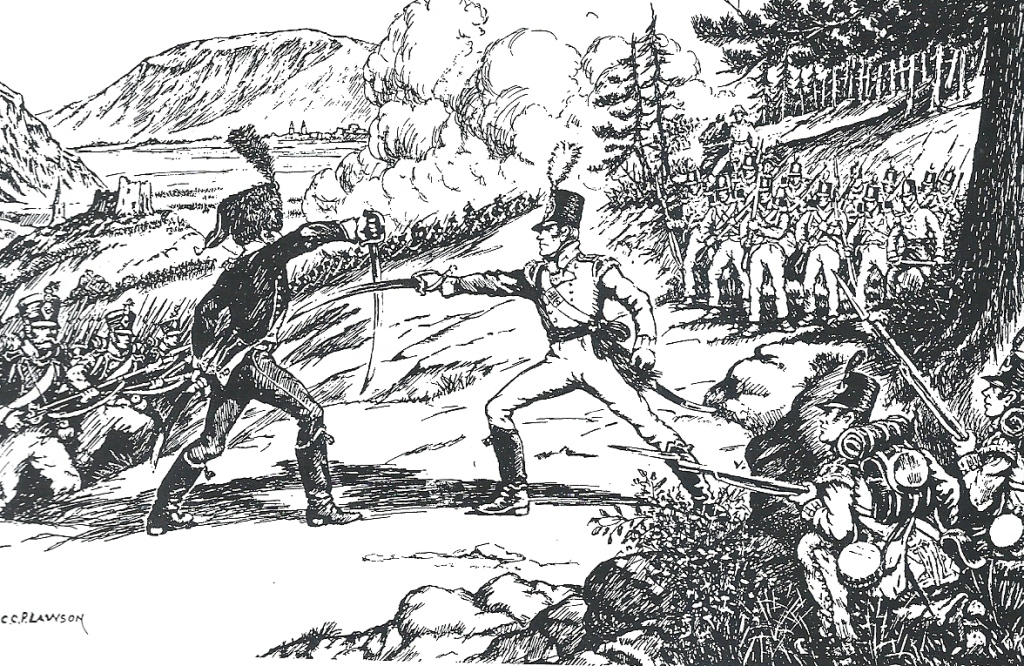
Captain Waldron's Duel to the Death, Battle of Castalla.
|
| Captain John Waldron accepting the invitation of a French officer to fight a duel at the opening of the Battle of Castalla. |
During the Peninsular War, the 2/27th Inniskillings, commanded by Brevet Lieutenant Colonel Reeves, landed at Alicante on 3 January 1813 and joined Lieutenant General Sir John Murray’s Anglo-Sicilian and Spanish army. They became part of the force’s Independent Brigade commanded by Colonel Frederick Adam. His brigade included English Light Dragoons, infantry from Portugal, the King’s German Legion, and the Calabrian Free Corps. There were mounted guns 'on troublesome mules' and hussars found from French army deserters of assorted nationalities, including Hungarians and Poles.
After various engagements, Murray’s army fell back to Castalla. Here, Marshal Louis Suchet’s army deployed in order of battle on the morning of 13 April 1813, and in three divisions attacked the left of Murray’s lines. Suchet personally selected a column of French Grenadiers to attack the very point where the 2/27th were deployed. It was there that a most unusual event took place. As the French column was deploying, one of their Grenadier officers advanced alone and challenged any 'English' officer to single combat. Captain John Waldron, ‘an agile Irishman of boiling courage’ of the 2/27th, advanced towards the French officer and accepted the duel. Their swords clashed as both sides looked on without firing a shot. Waldron downed his French opponent in the opening blows, whereupon the 2/27th rose as one from the ground and, with a mighty roar, bayonet-charged their opponents, scattering them down the hillside.
The French Officer's sword was a sabre d’honneur that had been presented by Bonaparte. Waldron seized the sword and it was sent by the Quartermaster General to The Duke of York who, being made aware of Waldron's heroism, ordered that he be promoted to Brevet-Major. Waldron had already distinguished himself in engagements approaching Castalla and had been mentioned in both General Orders and Despatches. Following the battle, General Murray stated in further Despatches that 'The most gallant charge of the 2nd Battalion, 27th Regiment, led by Lieutenant Colonel Reeves, decided the fate of the day.' Reeves too was promoted and became a (full) Lieutenant Colonel. The French were beaten and Suchet retreated.